
Understanding Our Bioluminescent Nights in Paquera Bay
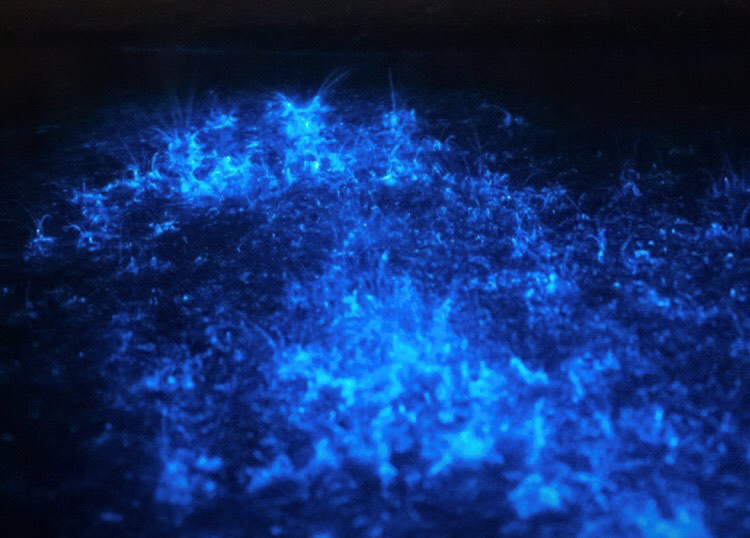
Here in Paquera Bay, part of the beautiful Gulf of Nicoya, we are fortunate to witness one of nature’s most extraordinary light shows: bioluminescence. Right now, we are experiencing a healthy bloom of a specific bioluminescent organism called Noctiluca scintillans.
During the day, this bloom can look surprising. The water may appear yellowish, cloudy, or even slightly milky on the surface. Some visitors initially worry that it might be pollution. In reality, this is a completely natural phenomenon — a bloom of microscopic marine organisms.
What Is Noctiluca?
Noctiluca scintillans is a species of marine dinoflagellate — a single-celled planktonic organism that drifts with the currents. Unlike many other dinoflagellates, Noctiluca is relatively large (up to 2 millimeters in diameter), which can make it visible to the naked eye under the right conditions. It is sometimes called “sea sparkle” because of its ability to emit light when disturbed.
Noctiluca does not produce light constantly. Instead, it responds to mechanical stimulation — meaning movement. When waves break, when a fish swims by, or when a paddle glides through the water, the cells experience stress on their membrane. This triggers a chemical reaction inside the cell.
The Science Behind the Glow
The light is produced through a biochemical reaction involving luciferin (a light-emitting molecule), luciferase (an enzyme that catalyzes the reaction), and oxygen. When the cell is disturbed, luciferin reacts with oxygen in the presence of luciferase, releasing energy in the form of light.
This light is typically around 475–495 nanometers in wavelength — in the blue-green spectrum. Cameras and videos often capture this glow as bright electric blue. However, to the human eye, especially in very dark conditions, many people perceive the light more as white, green or blue-green. This happens because our night vision relies heavily on rod cells in the retina, which are more sensitive to greenish wavelengths under low light conditions.
Why Does It Bloom?
Noctiluca blooms often occur when nutrient levels in the water are elevated, water temperatures are warm, currents are calm, and there is sufficient plankton available for feeding. The Gulf of Nicoya, with its sheltered bays, warm tropical waters, and natural nutrient cycles influenced by tides and rivers, creates ideal conditions for these blooms at certain times of the year.
These blooms are natural ecological events. While extremely large blooms in some parts of the world can affect oxygen levels, what we typically experience in Paquera Bay is a healthy, temporary phenomenon that supports the food chain and provides a spectacular nighttime experience.
From Daytime Mystery to Nighttime Magic
By day, the water may look cloudy or yellowish at the surface — a visible concentration of millions of microscopic Noctiluca cells. But when night falls and darkness settles over the bay, everything changes.
Every paddle stroke becomes a streak of light. Fish leave glowing trails. Your hands sparkle in the water. The movement of the kayak turns the ocean into a living galaxy.
This is not pollution.
This is not artificial light.
This is living, breathing biology.
Bioluminescence Costa Rica – At Bahia Rica, we are always attentive to the natural cycles of the bay. When a Noctiluca bloom is present — like right now — it creates some of the strongest, most concentrated bioluminescent displays we can experience.
Nature’s light show — powered by a single microscopic cell.